Video review here!
This week, I'm looking at MB’s Dragster from 1976, don’t worry if you’ve never heard of it, there’s a good reason for it...
The first thing that you notice is that this is a relatively small board game compared with others from it’s time, it’s nearly four times smaller than Monopoly and Mouse Trap, and sadly, the fun and the entertainment value is four times smaller too.
“The great dragster race game of speed and skill” I’ll be the judge of that, thank you. Dragster racing, you think of high speed excitement, exhausts spitting fire, huge rear tires, tiny bike wheels up front, cars that are pretty much a motorised missile on wheels. Well, forget all that when playing this game…
Opening the box, you’re presented with the game in it’s entirety. In fact, it’s one of the few games I know of that can be played in the box, this is it folks, this is what you get. The board is a moulded yellow piece with two slopes and two rubber triggers.
Each player gets four dragster cars and a marble. The pieces are nicely made but lacking detail, the board is certainly robust and I do like the little dragster cars, they kind of remind me of Micromachines.
Your aim is to ping your marble up the slope and it will land in one of the four lanes, pushing down the dragster car in that lane with it. Players fire their marbles at the same time so it’s a race of sorts to get all four cars down to the finish line and into the stalls, get all four cars down to the bottom, you win. That’s it. That’s the game. Sounds fun doesn’t it? Doesn’t it….?
All the dragster cars start at the top of the slope, there’s a small ridge at the top of each channel that the front wheels rest in. You then have to fire the marble up and hope that you end up pushing a car down the slope and over the finish line. You’ll find there’s always one channel that you can’t get the ball to land down, for me, it’s the one closest to the trigger. Again and again you’ll fire the marble up, but it’ll land exactly where you don’t want it too. You’d think that being sensitive to how hard to fire the marble up is the key to this and to some degree, you’re right. However, this little nub at the top of the slope allows the marble to bounce off and land in any of the four. It’s more a mixture of luck and skill that the ball ends up where you want it.

Trying time and time again to get the ball down the channel you want gets boring and tedious very quickly and in a game that’s over as quick as this, that’s not a good thing. The game is also flawed in that using the trigger tends to shake the cars off the start line and they’ll begin rattling down the track themselves.

This game blows…my mind with how much instructions there are with it! Preparation? Are you kidding me? With a diagram to show how to position the cars at the start of game. Thanks, I was gonna fire the cars off the trigger, phew, thanks for telling me! Then there’s all these instructions for a game as simple as this! The funniest rule is “if a marble is shot so hard that it flies into an opponent’s track, then it is a FOUL” what game of this would that ever happen?! Having read this I’ve tried to make this happen but it just doesn’t want to. I can’t make the marble leave the board at all. The instructions are all written in masculine pronouns despite the box having art suggesting it for girls too…and 5-14 year olds? Good luck finding a 14 year old who’d want to play this.
Just because a game is retro and old, doesn’t mean that it’s automatically a classic. Good games endure through brilliant design and creating a willingness to want to play again, they have to be overall fun. This fails to be entertaining due to the repetitive and tedious nature of the game mechanics, it’s overall boring. The game’s saving grace is that at least it’s quick to play and when you’re fed up of it, playing it out the box means that putting it away is quick too. It’s about as much fun as being on a pinball machine and just letting the ball fall through the flippers each and every time. Like I said at the start, there’s a good reason this game is obscure and forgotten about, there’s better classic games to play.
Video review here!
Okay, this week we’re going to look at an absolute classic of a board game, one I’m sure all of you have owned or played at some point. It’s the grandaddy of 3D board games, Mouse Trap!
Would you believe that this game is over fifty years old? It’s true, Mouse Trap was first introduced by Ideal Games in 1963, yes this game is fifty four years old!
I think of this as a vintage board game because it’s from my childhood, my copy here is from 1993, but knowing that my mum used to play this as a kid, this is a true enduring classic.

You can see from this 1963 copy, to my 1993 copy, to a modern day copy the elements have barely changed at all. The board graphics have been updated and changed over the years and there’s a number of different iterations, but the actual pieces have remained the same over the decades. This is undoubtedly due to incredible and enduring design. Pieces are interchangeable from generation to generation and the fact this game has continued to entertain children for decades means that mums and dads will instantly remember how to play.
The game is very simple in how it plays and ultimately is a roll and move game. Players pick a coloured mouse and everyone starts at Home. You roll the dice to move, and progress along the outside of the board. As you move around the board, certain spaces will have “Add a piece” written on them, and you sequentially add the components to the trap.

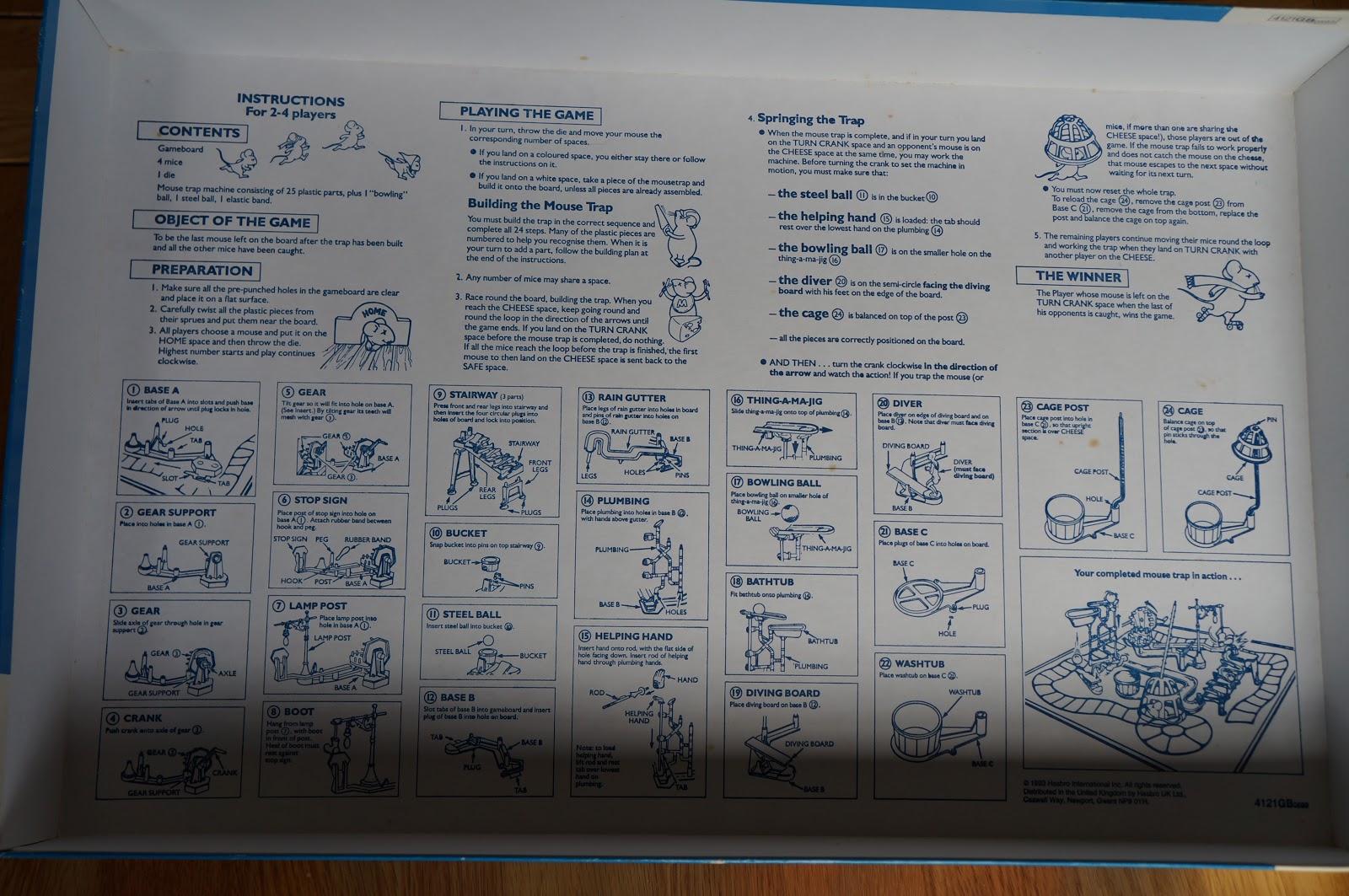
The box lid contains the intricate and detailed instructions to build the game up, look at this thing! “Slide axel of gear through hole in gear support 2” “slot base B into game board and insert plug of base B into hole on board” This is like putting up an Ikea wardrobe! It astounds me that kids are able to construct this, much more to a point where it actually works.
Looking at the pieces, it really tells a story. The components are all for the most part household items and you get the feeling the poor person who devised this mad cap contraption was so completely sick of his vermin problem that he tore his house apart to create this mad, Rube Goldberg-esque trap. Plumbing, bathtubs, guttering, his own boot, even the lamp post from outside, this speaks of a last ditch effort to snag those mice.
The owner has a dog and a cat, what are they doing to stop these mice! The one game piece I’ve always wondered about is the diver…is it a statue of a diver or is it an actual human stood waiting for this bowling ball to fling him in the air? Where would someone get a statue like that and why would you want it in the first place? If it’s a human then why not just jump in the tub when you see the mouse under the trap?
One other thing I want to say about the game pieces seemingly vary in colour from set to set. Even on the box here certain pieces are different to what you get inside but I’ve seen blue plumbing, green divers, blue seesaws, it’s a bit of a lucky dip.
As you progress around the board the the trap will begin to take shape. It’s exciting to see it come together bit by bit, replaying the game now I was surprised how quickly it came together, i seem to remember as a kid it being an agonising wait to see the thing completed.
The board has a number of spaces that serve to prank the player. “If 2 mice here go back 6 spaces”, c’mon!
“Do NOT add a piece” All the Add A Piece spaces are white so rolling and landing on this space you think for a split second you’re adding to the building of the trap….right up until you read it.
By far the worst is “Go to cheese” oh great, thanks game! Put me right under the trap! Jerk… Being moved back along the board isn’t such a bad thing, it takes you further from the trap space and when trying not to get caught, you’re relieved to be moved further away from danger.
Most games, the trap will be built up by time you reach the end of the path, the death loop, the hoop of doom, the circle of entrapment, six spaces that loop infinitely round and round. The game changes quickly into a last man standing, sorry, last MOUSE standing scenario. It’s ultimately luck that decides the winner, you can only crank the machine if you land on the crank space AND if another mouse is on cheese. Unfortunately, this takes FOREVER.
Replaying this game, it took half the entire play time just for the two mice to line up on those squares. This seems like such a cruel tease, you have this amazing looking contraption you’re dying to see going, you land on crank but no-one is on the cheese, nope, can’t turn that crank, can't see the trap in action. The more players playing, the quicker this seems to be other but when it gets down to the final two, it becomes a game of cat and mouse….mouse and mouse.
So, here it is, the time has come, I’m on the crank, you’re on the cheese, you cheddar brie-lieve you’re getting trapped…that was edam awful pun. You turn the crank and….it doesn't work...
Yes… the machine doesn’t always work perfectly every time. In fact, the game fully holds its hands up and admits this. I can’t decided whether this was intentional or not, to have it work some of the time. In either case, it adds a tense element to the game, you’re hoping that the trap messes up for you if you’re under it. Fate always seems to have a laugh at your expense with it seemingly failing every time you turn it and it being flawless when your opponents do.
When it does work however, this thing is spectacular. What a joy it is to see this thing all working. It’s over in around twenty seconds but you’ll want to set it up and see it going all over again.
Mouse Trap is still being made today, updated box and board graphics, I doubt there’s any drunk or dead mice on the modern variant but the same game components, same trap, same game play. There is however, a new rule included. Around the board are “cheese” squares, where you collect a piece of cheese. These pieces can be used in the loop of doom segment to really be vindictive to your foes. You can use a cheese piece to roll the dice to move an opponents mouse, hopefully under the trap! I like the sound of this, you know by now that I love games with a bit of back stabbing to them.

As enduring as this game is, MB tried to reinvent the wheel. They created a new Mouse Trap in 2004 that, again, is still being sold. The core difference with this version is that the game has multiple traps. It’s random how these traps are activated, you flush the toilet (yes) and a ball bearing is sent spinning which will pop out into one of the three different traps. If I’m being honest, i’m not so keen on this variant, the construction of the traps is too engineered and loses that Heath Robinson look to the game, it bodged together with random junk. The traps themselves are much shorter to activate and the the chain reaction/rube goldberg element to it is missing. It plays a lot like Ghost Castle or Incy Wincy Spider, where random traps that briefly inconvenience the player.

It’s not difficult to see why this game has continued to sell for over half a century. It’s fun, visually it looks spectacular and interesting, there’s really no other game that you can compare it too. What other game do you assemble a bunch of random household objects to capture a creature the size of your thumb? It’s one game that people of all ages can enjoy and watching the trap in motion never gets tiresome.
Video review here!
Here’s an unusual toy in that, well, in truth, you don’t really play with it, it kind of does that for you. It’s the follow up and expansion for Big Loader, BIG BIG Loader!
My brother owned Big Loader as a young kid, we’d set it up and watch it going for hours. When my mum saw and heard that there was a second one coming out, she thought it’d be good for me and my brother to share both sets and bought me Big Big Loader for my birthday.
I remember the advert for Big Big Loader, it’s catchy jingle, and the size of it compared to Big Loader, they weren’t kidding, it looked huge! Sadly, Big Loader is missing some parts, they’re probably bouncing around up in the attic somewhere, and I would've loved to have shown you both of them at the same time. Maybe that’s one for a later episode if I’m able to find them.

The box in the eyes of my six year old self was practically a colossus, it was one of the largest toys that I owned at the time. The toy inside is described as a construction set, though this I find this to be a lapse description of it. Lego is a construction toy, K’nex and Meccano are construction toys, you build things with them. I wouldn’t call Mousetrap a construction toy simply because I build the trap up. It’s like saying any toy that has “some assembly required” is a construction toy… it’s not. Whilst I agree that Big Big Loader is a system of sorts, only certain parts will work in certain sequence, it’s not like you can reconfigure the pieces into a new layout, you’re really pretty much stuck with the one layout.
That’s not to discredit this toy in the least bit, not in the slightest. The engineering gone into this thing is nothing short of staggering.
Everything, and i mean EVERYTHING, is powered off this one simple motor, this one little engine that operates the trucks, the lift, the scoop, the elevator, it’s incredibly well thought out.
Sections of the track will have these small raised teeth to make the truck move slower, the design of this scoop digger here is incredible, it’s a simple shell that fits over the engine yes, but the fact that this motion of scooping up the balls, lifting them up and tipping them out is all done by forward motion from a simple motor, I can only imagine the trial and error getting this just right.
By far the most impressive portion of the track for me personally is the elevator, the motor locks into place just perfectly to catch these gears which drive the elevator upwards. When it reaches the top, the motor is released and the little truck can trundle out, amazing!
The components to this are all bright coloured and very similar to Tomy’s Train system of the time, it just looks a fun and entertaining. I’ve long since lost the instructions to this thing but setting up the layout is relatively simple, everything clicks and pops into place perfectly.
So, what does the toy actually do? Well, it’s a infinite loop of work on a construction site, it doesn’t matter particularly where you start the motor off as it will eventually pass through all points. The loop works like this. The motor first goes into and under the scoop digger, it travels around the track and scoops up the small black balls and drops them into this collection bay.
The digger reverses back into its garage, the motor slides from underneath it and then underneath the truck. The truck then reverses into the collection bay and collects the balls in it’s little hopper.
Next, the truck approaches the elevator and rides up to the first floor. The truck, exits, turns around and backs slowly to this spiral. When it hits the back, the truck lifts it’s hopper, tips all the balls into the funnel and sends them spiralling down into the lift.
The truck then slowly moves away from the spiral and stops to raise the lift up, the lift rises, the balls run along this bridge, down this slope and back onto the path, ready to be scooped up again by the digger.
The truck trundles back into the elevator, it drops down to the first floor and the cycle repeats.
As I said, this is all the toy does, you don’t interact with it at all other than setting it all up. But it is utterly mesmerising to watch, and satisfying to boot, you’ll find half an hour has gone just watching this little process go on and on and on.
You could attach Big Loader to Big Big Loader, you had the option of switching the motor between the two tracks, a pretty neat idea and the two together made an enormous set.
It’s not hard to see why I’ve held onto this toy over the years, it’s just so charming and wonderful to watch in motion. Again, I'm amazed by the ingenuity of Tomy to create all this motion and action of one little motor. Bringing this down has definitely put a smile on my face.
Talk about attic treasure! THIS is Curse of The Idol from 1990 by Milton Bradley, just feast your eyes on this!
I know i’ve fawned over artwork and packaging before but just look at this thing, that’s how you do box art! There’s no other way to describe it, this is a masterpiece. It immediately reminds me of Temple of Doom. It’s got that old adventure serial look nailed down, almost like the fantastic artwork by Drew Struzan, he’s the artist who painted the Star Wars, Blade Runner, Indiana Jones, Goonies and Back To The Future posters, to name but a few. “Defy danger to capture the bloodstone!” Blood, danger, curses, this game knows how to lure in it’s audience!
The quality of the theming and artwork doesn’t end with the box, the board and game pieces are phenomenal. Honestly, I can’t think of a single board game from this era that paid this much detail to theming, this is a work of art.
Thundering rapids tear through the dense jungle, crumbling ruins and broken statues are strewn about the once glorious temple.

The board is full of wonderful details like snakes, pits of skeletons, secret staircases, it’s marvelous.
Assembling the board can take some time if you’re not familiar with how the components all fit together. I can get this done now in around five minutes or so. Yeah, this is such a gargantuan task that the assembly instructions take up the entirety of the inner box lid! There’s four plastic corner pieces, that hold the the outer temple walls, two clips that slide under the rear wall and another two clips to hold the inner temple walls. The frame for the Wheels of Death slides into and under the board, this also helps with keeping the board solid. The discs are fitted to the cogs, the cogs are fitted to the frame, the plinth added and the golden sword put in place. The inner temple door is also fitted to the small rear cog. The back to the idol is put in place and the bloodstone inserted. Giving the idol a shake and a good turning over helps the bloodstone fall into one of these six segments, this is important and will become clear when we start the game. The idol is carefully placed into the inner temple and-PHEW!- we’re done!

Just take a second here to admire this, it really looks impressive.
The graphics to the walls are completely different to one another and different on the inside too, creeping vines snake all over the outside whilst ancient torches still burn on the inside. Talk about immersion!
The artist was clearly proud of his work, in fact, he sneakily hid his name in the game! I see what you did Don Lawrence, you don’t get past old Lukey!
Looking up Don Lawrence, he was a fairly prolific and infamous comic artist from the UK, his style was oil painting and he worked on the long running SPAWN comic. Amazing to think that MB hired on an artist like this to theme their game, I can only wish that this still happened today.
The game pieces are similarly very well made, the miniatures are nicely detailed. The idol feels robust and has this dull bronze/gold finish to it.
Looking at the manual, it has a great adventurer’s journal/ comic book feel to it.
Starting the game, you pick your favourite colour figure, everyone starts at the base camp, the villain starts in front of the sword plinth. Ah yes, did I not mention this game has a villain? We’ll get back to him shortly.
Your objective is to obtain the golden sword and make your way to the inner temple via the Wheels of Death. Once in the temple, you then have a one in six chance to correctly insert the sword into one of the slots on the idol. Guess wrong, you go to the PIT OF BONES!
Guess right however and you’ll free the Bloodstone! Then it’s a race back to the basecamp, but all the other players are trying to steal it and the glory from you!
You role a dice to determine how far to move but you have the option of either moving your piece…or the villain!
The villain has some interesting play mechanics to him. Firstly, he cannot leave the temple, nor can he enter the inner temple where the idol is. This is a good thing as someone would have the idea to move the villain in there and spoil the game for everyone else. Secondly, he acts as a dead end to any path he is on, player pieces cannot pass him and must find an alternate route around. Third, if the the villain lands on another player, that player is cast into the Pit of Bones!
There’s two pits of bones, either side of the idol, it’s player choice which one to put the play piece in. The pit of bones doesn’t require a specific dice role to get out of nor any turn loss, but it does take that player out of the action and away from the entrance to the inner temple. Additionally, if the the villain lands on a player carrying either the golden sword or bloodstone, they go to the player who moved the villain. A tremendous amount of strategy is added with the inclusion of the villain and you'll often need to think carefully about whether it best to move your figure or the villain. Do you move closer to the temple entrance or move the villain towards your opponents? Do you block their path with him or move yourself closer to getting the sword or the bloodstone?

Throughout the course of the game treasures will change hands constantly, whether through using the villain or landing on the treasure holder with your own game piece. With everyone out for themselves, it’s adds a frantic pace to the game, I like to think of the pieces fist fighting over treasure, like Belloc and Indy fighting over the ark of the covenant!

Now onto the most interesting mechanic of the game, the WHEELS OF DEATH! Dotted around the board are these cog symbols, you land on the cog, you give the sword plinth one whole turn clockwise, or turn enough to 180 the temple door. As you can see, the three large cogs have different paths on them and you’ll find that routes regularly open up and close to you. Again, you can really be quite vindictive and prevent your foes from getting close to the temple door. You can also use the cogs to swing you closer to the door, or swing the villain closer to your enemies! Some player managed to land on the temple door and rotate into the inner temple? Rotate him out of there! There’s a lot of strategy to this mechanic and for the most part, it works well.

Getting to the inner temple with the sword, you then have to make a choice, which slot to put the sword into? Getting the guess wrong sends you to the pit of bones, the sword back to the plinth and the race starts all over again, with all the players knowing that was the wrong slot… you chose…poorly. I’ve played a few games where it’s been the very last guess, by that time, you’re more than relieved to see the bloodstone.
So, you have the bloodstone, you have to get out of the temple and back to basecamp to win. There’s only the one way into the inner temple, but there’s three ways out, these trap doors put you right near the pit of bones. You can opt to go out through the Wheels Of Death but this can end up being a long process with paths being constantly blocked off to you by jealous and greedy rivals. Once you clear the temple, you’re pretty much home free as players can’t use the villain as second option to capture you and the stone. You made it back, you won, fortune and glory are yours!
With all the action elements to this game and the superb theming and setting, you’d think I’d not have any complaints with this right? Sadly, this game has some pretty big flaws. Firstly, stealing treasures, it’s far too easy to do this and when you’ve spent ages getting to the sword plinth or retrieving the bloodstone, you can feel a little cheated by this, of course, that’s all part of the game, but using the villain to get treasures can really be exploited, especially when it comes to the blood stone.

A player can have his character hanging around the temple entrance and have the villain jump the player with the bloodstone, the bloodstone then going to him. With him being so far from the other players, there’s absolutely no chance they’ll catch him unless they get very lucky and roll a succession of sixes, six means you roll again. A house rule we implement is when a player lands on another player, we play rock paper scissors to determine the winner of a duel. The duel winner keeps the treasure. You could also do this by having the player roll a four or higher, bring it down to 50/50 chance.
Another house rule we implement is that when the bloodstone is free, landing the villain on the player holding the bloodstone doesn’t mean that the stone goes to that player. No, the villain’s objective in the manual is to guard the stone for himself, so the bloodstone now goes the sword stone in front of the idol. This does a lot to fix the end of the game, it ends far too quickly otherwise and using this house rule, it kind of extends the objective of getting into the inner temple seen in the first half of the game.
Aforementioned, certain games have had the bloodstone drop on the final guess and this can get really tedious with everyone battling to get into the temple, stealing the sword of each other, sending each other to the pits of bones. Players seem to forget that letting others get to the temple helps them! If they guess wrong, well, you know not to put the sword in that slot if you get there, if they guess right, well they saved you a job. But a game where it can take six attempts to free the objective, it can feel long in the tooth. I’ve implemented a rule where you role the dice to determine how many attempts you get at guessing which slot the stone is in. This does wonders for speeding the game along, the first time replaying this game without this rule it lasted two hours! I’m not kidding!

The Wheels of Death and the temple door are a particular pain in the backside. Just when you think “yes I’m in!” Some spiteful player will spin you out again. Seeing as it takes an exact number roll to land on the temple door place to get rotated inside in the first place, this can take forever. In fact you’ll be long in your own tomb before the game ends! It’s like the fireplace out of The Last Crusade, this is intolerable! A player will patiently sit hoping that they’ll get rotated back in before their turn comes around. My thinking is that, you’ve made it this far, you got to the temple door, you’re rotated in and that takes effort. Just move the player off the door and into the square inside the inner temple. This again does a lot to speed the game along and keep it fun, it’s not fun being span round and round that temple door like a rotisserie chicken.

In conclusion, Curse of the Idol remains a forgot game from yesteryear, I think personally it deserves more recognition that it gets, there’s absolutely no denying that this game looks terrific, there’s some interesting game play and mechanics to it that really set it apart. As mentioned in my Labyrinth review, I love games where you get to pull the rug out from under your opponents feet and this is one of them, there’s backstabbing and strategy to it in spades. It’s just sad that the rules which come with the game are so flawed, that’s the real curse of Curse of the Idol. There’s a really excellent game here if you’re willing to think about adapting rules and instructions though. I’ve played this game with 2, 3 and 4 players and have found it massively affects the way the game plays, there's A LOT more strategy involved with more players. You can find copies of this game quite easily on eBay, if you’re up for an adventure, considering picking this one up. Fortune and glory can be yours!